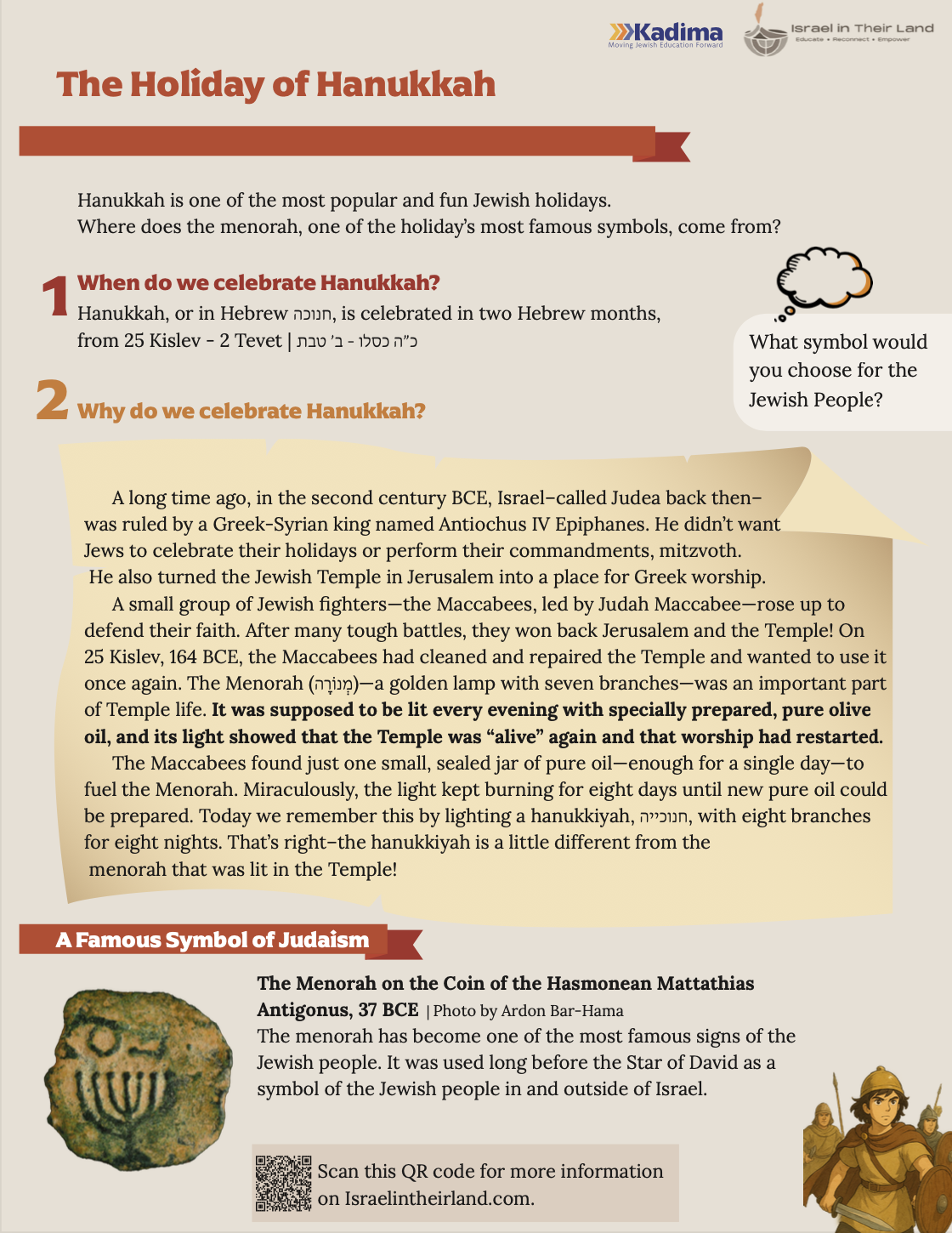
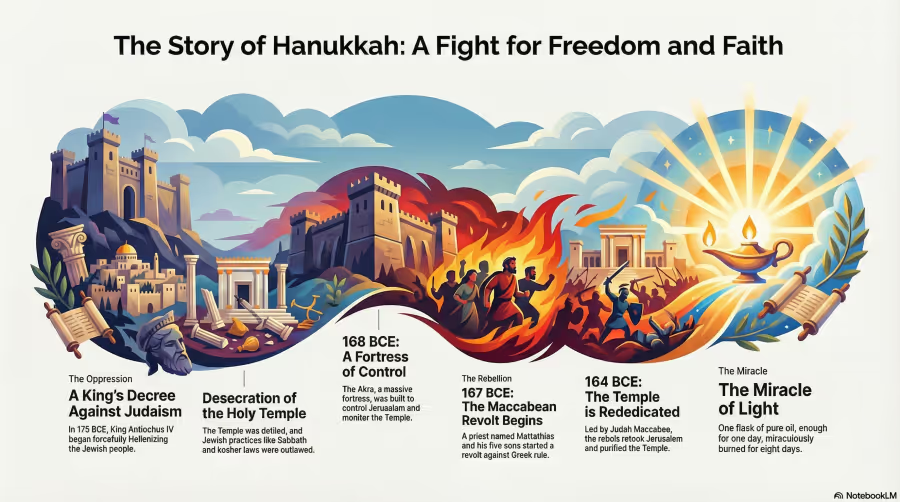
The Hebrew word Hanukkah means “dedication,” and this holiday commemorates the rededication of the Holy Temple in Jerusalem by the Maccabees after the Greeks defiled the temple.
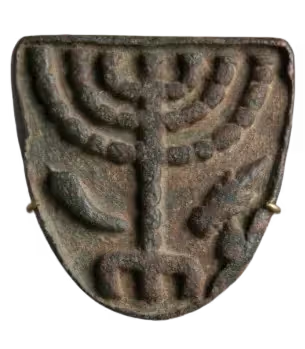
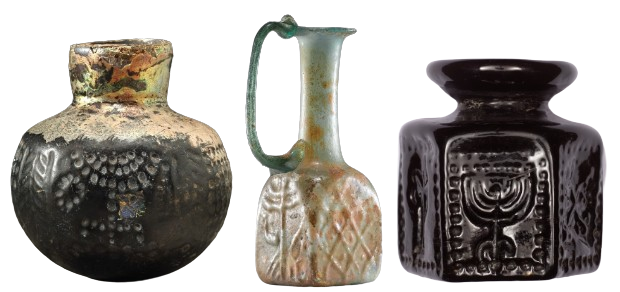
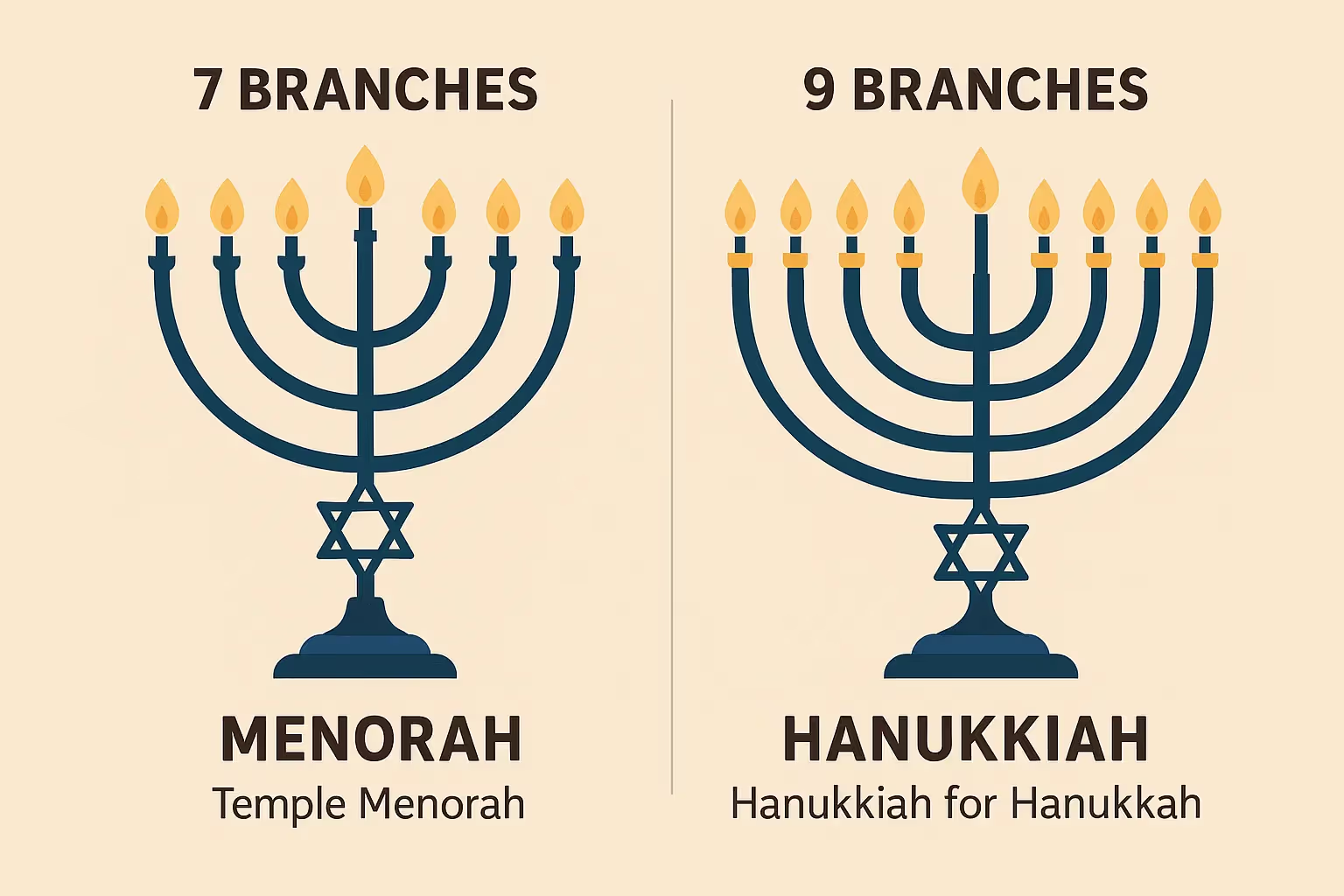
During the eight-day festival of Hanukkah, we light the "Hanukkiah". Starting with one candle on the first night, adding a candle each night, until we light eight candles on the eighth day. A Hanukkiah, a nine-branched candelabrum, represents the re-sanctification of the seven-branched Temple Menorah as its oil burned miraculously for eight days after the Maccabean victory.
2 Maccabees 10:5-6
“On the anniversary of the day on which the Temple had been profaned by the foreigners, that is, the twenty-fifth of the same month Kislev (around December), the purification of the Temple took place. The Jews celebrate joyfully for eight days…”
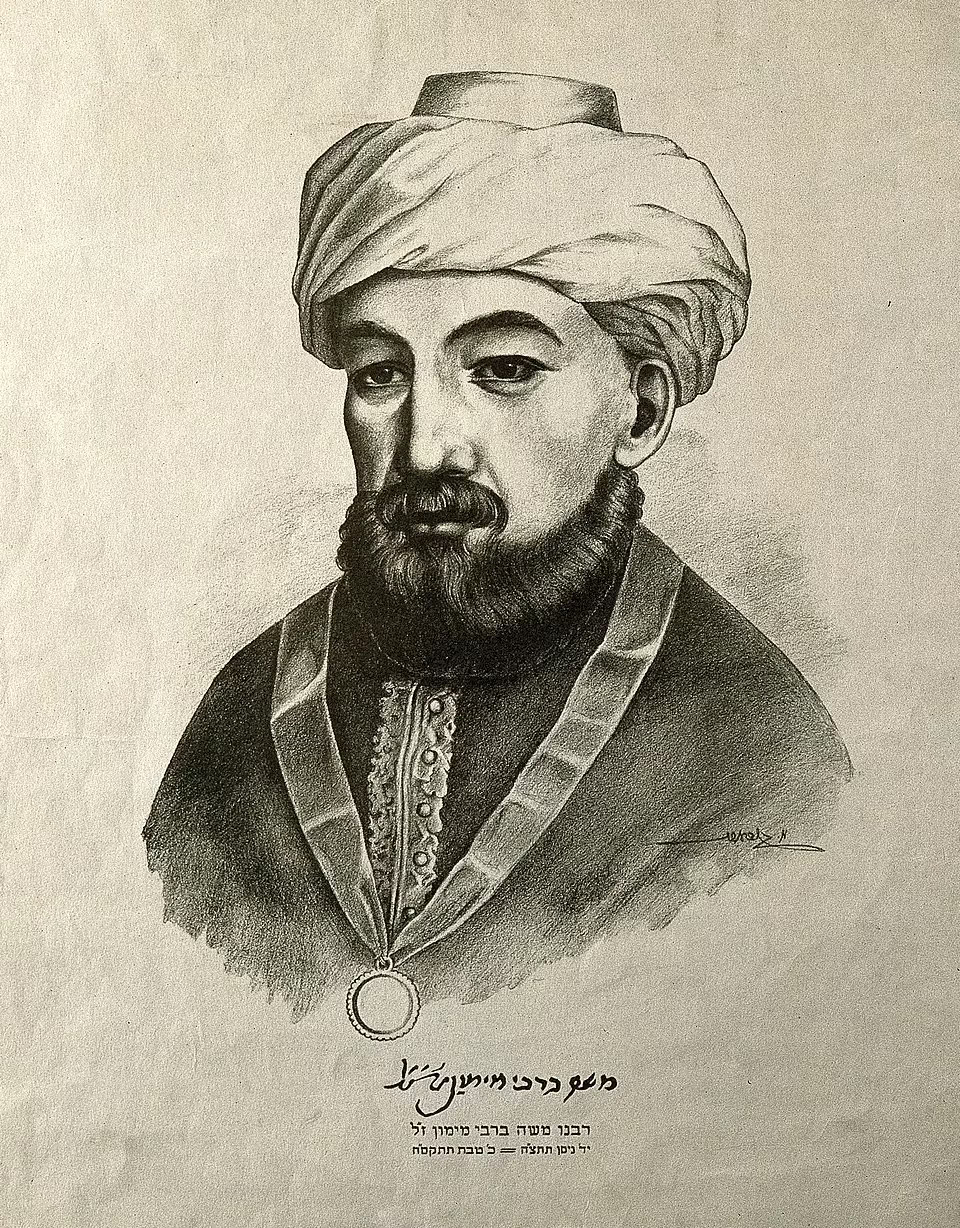
The Mishneh Torah, Scroll of Esther and Hanukkah 3:2-4
"When, on the twenty-fifth of Kislev, the Jews had emerged victorious over their foes and destroyed them, they re-entered the Temple where they found only one jar of pure oil, enough to be lit for only a single day; yet they used it for lighting the required set of lamps for eight days, until they managed to press olives and produce pure oil.
Because of this, the sages of that generation ruled that the eight days beginning with the twenty-fifth of Kislev should be observed as days of rejoicing and praising the Lord. Lamps are lit in the evening over the doors of the homes, on each of the eight nights, so as to display the miracle. These days are called Hanukkah, when it is forbidden to lament or to fast, just as it is on the days of Purim. Lighting the lamps during the eight days of Hanukkah is a religious duty imposed by the sages."
Talmud, Shabbat 21b:
When the Greeks entered the Sanctuary, they defiled all the oils that were in the Sanctuary by touching them. And when the Hasmonean monarchy overcame them and emerged victorious over them, they searched and found only one cruse of oil that was placed with the seal of the High Priest, undisturbed by the Greeks. And there was sufficient oil there to light the candelabrum for only one day. A miracle occurred and they lit the candelabrum from it eight days. The next year, the Sages instituted those days and made them holidays with recitation of Hallel and special thanksgiving in prayer and blessings.

In the second century BCE, a shift in power from Ptolemaic (the Greeks from Egypt) to Seleucid Greece (the Greeks from Syria) saw a significant and hostile change towards Jewish worship in the Land - a war between paganism and Judaism Until this point, no one in the ancient polytheistic world declared war on another people's religion. The modest Jewish life with laws, rituals, and values given by One G-d, prescribing care and consideration for creation and one's fellow man while uplifting the oppressed, uncomfortably opposed Greek ideals which incorporated a plethora of gods and glorified the body.
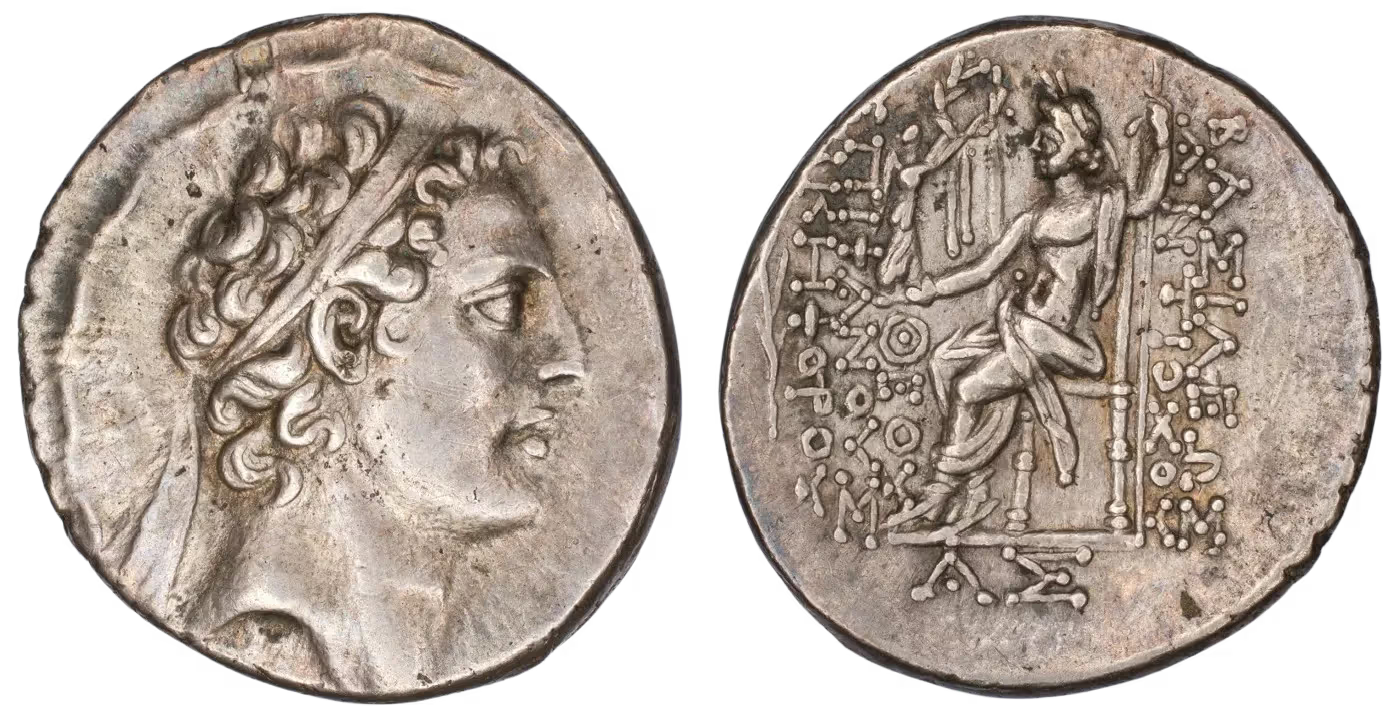
With Antiochus IV taking the throne, gradual, deliberate, and later forceful steps to Hellenize the Jews were put into place, strategically "gutting" the essence of Jewish religious practice, leaving only a shell of pretense that would easily accommodate Greek ideologies. One of his first actions was to take control of the Temple by undermining the office of the High Priest. Next was destroying the Jewish Calendar. Jewish appointed times, including the Sabbath, holy festivals, and the sanctification of the New Moon, are part of the Jewish responsibility to sanctify time. Prohibiting the Jews from this observance would severely impede them from practicing Judaism. The prohibition of keeping kosher and the study of Torah followed, and finally, he forbade circumcision, the physical sign of the Jewish covenant with G-d.
1 Maccabees 1:45-50
“He (Antiochus IV) ordered them not to offer burnt offerings, grain offerings, or wine offerings in the Temple, and commanded them to treat Sabbaths and festivals as ordinary workdays. They were even ordered to defile the Temple and the holy things in it. They were commanded to build pagan altars, temples, and shrines, and to sacrifice pigs and other unclean animals there. They were forbidden to circumcise their sons…”
1 Maccabees 1:60-61
“Mothers who had allowed their babies to be circumcised were put to death in accordance with the king's decree. Their babies were hung around their necks…”
Josephus, Antiquities 12.5.4
“...the King (Antiochus IV) had built an idol altar upon God’s altar he slew swine upon it…”
Under the epitaph Epiphanes, meaning “God Made Manifest”, Antiochus introduced religious persecution to the world and specifically the Jews.

In 168 BCE, Antiochus IV built a fortress called "the Acra," in order to control Jerusalem and monitor activity in the Temple. Acra in Greek refers to a reinforced citadel.
Josephus, Antiquities 12.5.4
“... the King (Antiochus IV) came up to Jerusalem… And he burnt the finest parts of the city and, pulling down the walls, built the Acra in the Lower City; for it was high enough to overlook the Temple, and it was for this reason that he fortified it with high walls and towers, and stationed a Macedonian garrison therein."
Various writings describe the Acra as a thorn in the flesh of the Jewish inhabitants of the City of David (Ancient Jerusalem), as Jews who joined the wicked ruler as Hellenists, mocked their fellow "narrow-minded" Jews for "suffering" from their outdated religious traditions.
1 Maccabees 1:33-35
"They (the Seleucid forces) then rebuilt the City of David with a great, strong wall and strong towers and made this their Citadel. There they installed a brood of sinners, of renegades, who fortified themselves inside it, storing arms and provisions, and depositing there the loot they had collected from Jerusalem..."
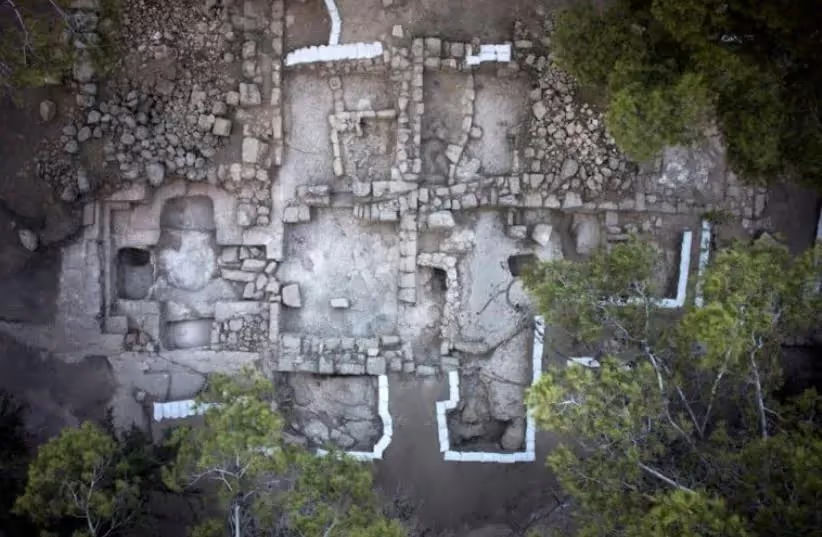
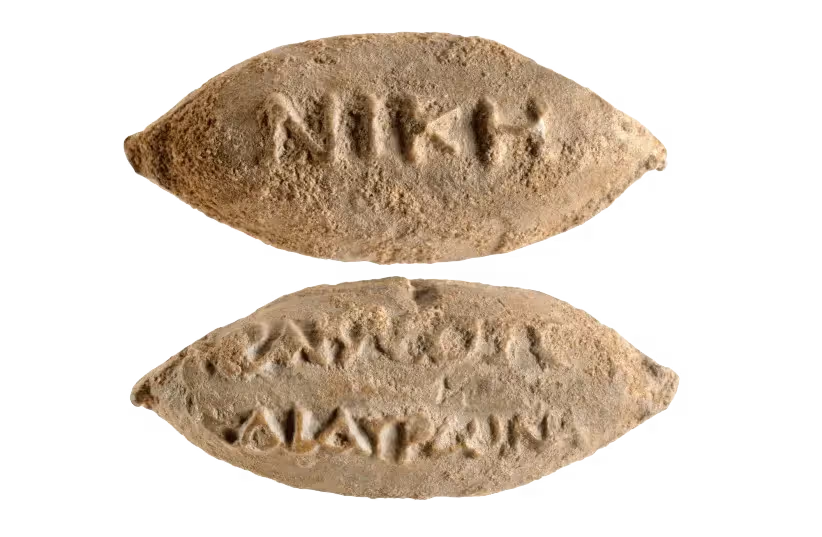
In 2015, its ruins were discovered in the City of David, the location of Ancient Jerusalem, placing the Acra south of the Temple Mount, in the center of the City of David, spreading its colossal self over the width of the whole southern hill. Its location severed the Temple Mount from the rest of the city. The excavation produced bronze arrowheads and ballista stones, numerous coins, ranging in date from the reign of Antiochus IV to that of Antiochus VII testifying, to the citadel’s chronology.
The religious oppression under the Greeks took a turn in 167 BCE, when the soldiers of Antiochus IV entered the city of Modi'in, 13 miles northwest of Jerusalem, and ordered Mattathias, a priest, to slay a pig on a pagan altar. Mattathias refused, overturning the altar and slaying the king’s general.
This began the 35-year-long Maccabean revolt led by Mattathias and his five sons: Judah the Maccabee, Eleazar Avaran, Simon Thassi, John Gaddi, and Jonathan Apphus.
Mattathias’s son Judah’s nickname was Maccabee, which means “the Hammer”. Some believe it referred to his ferocity in battle, others say the hammer was his weapon of choice. Maccabee is also the Jewish acronym for "Mi Kamocha Be'eilim Hashem," meaning "Who is like you among the powers, O G-d," which was used as a battle cry amongst the army ranks.
Josephus, Antiquities 12.6.2
“But when those that were appointed by the King (Antiochus IV) were come to Modin, that they might compel the Jews to do what they were commanded… But Mattathias said, “He would not do it: and that if all the other nations would obey the commands of Antiochus, either out of fear, or to please him; yet would not he nor his sons leave the religious worship of their country.”
1 Maccabees 2:27
And Mattathias cried throughout the city with a loud voice, saying, whosoever is zealous of the law, and maintains the covenant, let him follow me!
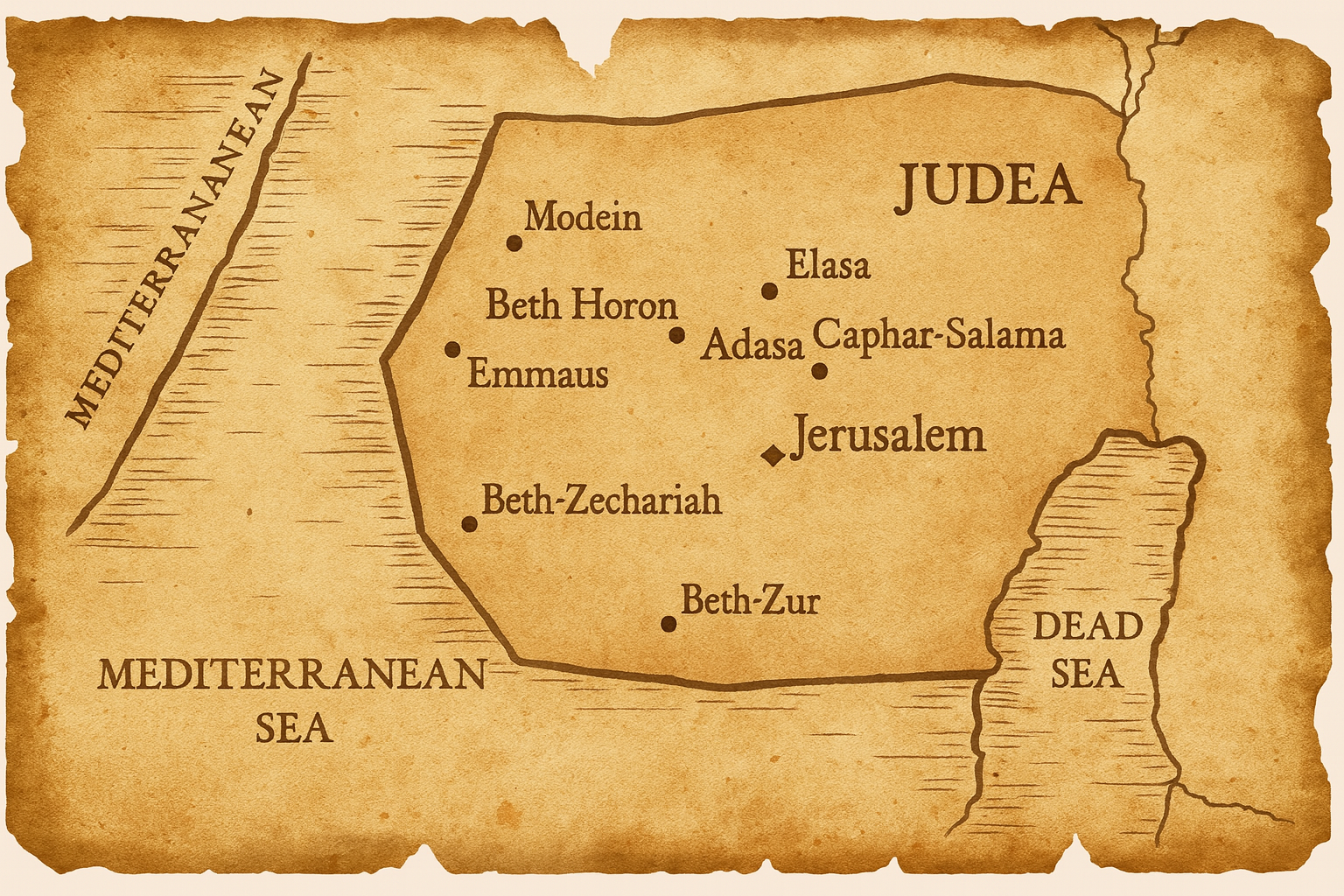
The Greeks vastly outnumbered the Maccabean army in number, equipment, and skill. At first, the Maccabean forces employed guerrilla tactics in the Judean countryside, but over the span of 30 years, the movement developed into a proper army capable of attacking the fortified Seleucid cities. The majority of the battles took place in the foothills leading up to Jerusalem.
Key Battles include:
166 BCE - Battle of Beth Horon
165 BCE - Battle of Emmaus
164 BCE - Battle of Beth Zur
164 BCE – Battle of Temple Mount and the rededication of the Temple, still celebrated today as Hanukkah.
162 BCE - Battle of Beth Zechariah; Eleazar Avaran dies in battle
161 BCE - Battle of Adasa
160 BCE - Battle of Elasa; Judah Maccabee dies in battle
160 BCE - the sons of Jambri kill John Gaddi from Medeba
142 BCE - Diodotus Tryphon executed Jonathan Apphus at Baskama, east of the Jordan
Mattathias died in battle somewhere in 166 BCE.
After three years of battle, the Jews were able to retake Jerusalem, except for the Acra fortification. Reaching Temple Mount, they found the Temple disgraced and converted into a pagan sanctuary, riddled with idols, and the altar defiled with pig's blood. Judah purified and rededicated the Temple on the 25th of Kislev, 164 BCE, and established the Festival of Hanukkah, the Hebrew word meaning "dedication".
Josephus, Antiquities 12.7.6-7
“ And so Judah and his fellow citizens celebrated the festival of the restoration of the sacrifices of the Temple for eight days, …they made it a law for their posterity, that they should keep a festival on account of the restoration of their Temple worship for eight days. And from that time to this, we celebrate this festival, and call it Lights. "As referred to by Josephus, the festival of Hanukkah is celebrated for eight days.
The Talmud (Shabbat 21b) sheds light on the reason:
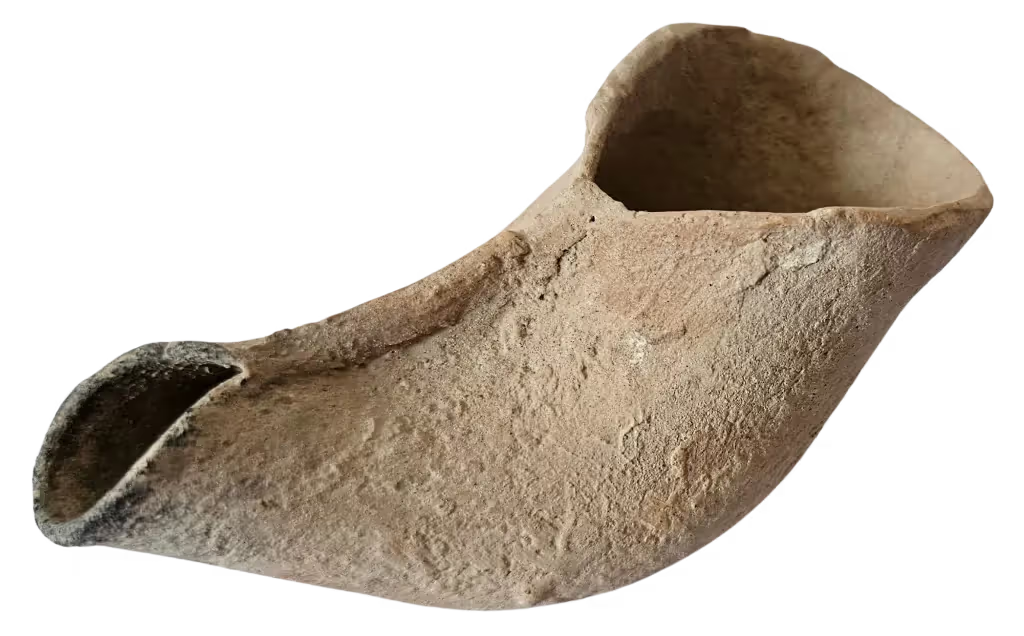
"And when the royal Hasmonean House gained the upper hand and vanquished [the Greeks], they searched and found only one flask of oil.... with the High Priest's seal, and it contained only oil to burn for one day. A miracle occurred and it burned for eight days. The priests used the vial of pure oil to light the menorah's candles.
After the victory and restoration of the Temple, Judah undertook wars throughout the Land of Israel to eradicate paganism from the country and eliminate Hellenizing rivals. Judah was killed in the battle of Elasa against the Seleucids in 160 BCE. The Hasmonaeans now rallied around Jonathan, his brother. Jonathan turned his focus towards fortifying Jerusalem and cutting off the Greek garrison fortifying themselves in the Acra.
Josephus, Antiquities 13.5.11
“Jonathan gathered all the people together in the Temple and advised them to repair the walls of Jerusalem, … and, in addition, to build still another wall in the midst of the city to keep the garrison in the citadel (Acra) from reaching the city, and in this way cut off [the garrison’s] large supply of provisions.”
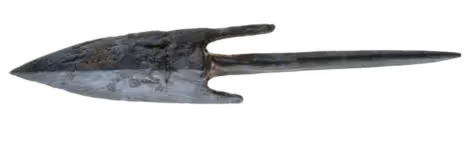
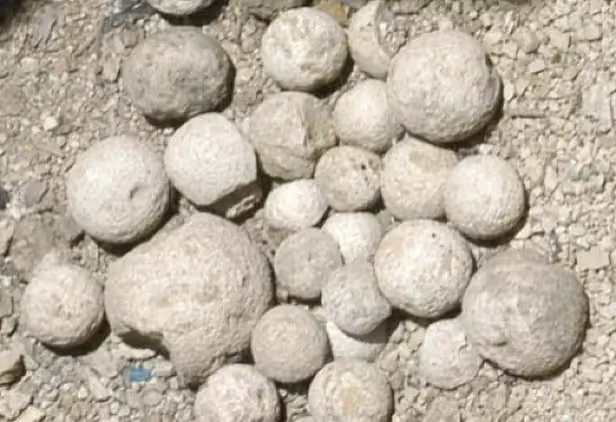
Pictured here are Hasmonean Sling Stones, Seleucid arrowheads, and sling bullets. The word "victory" is inscribed on one side of the sling bullet.
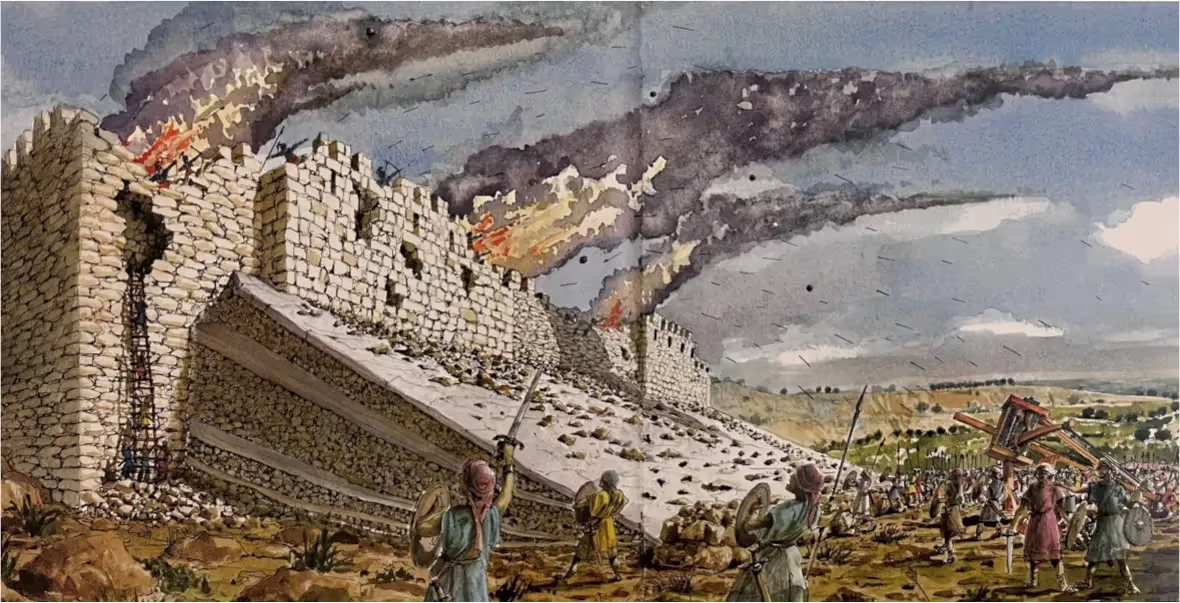
Four of the five brothers fell in battle. Simon, the last brother of the priestly family took up the position of High Priest and continued the battles against Greece. King Demetrius II and Simon finally agreed to a peace treaty in the year 141 BCE. But the Acra still stood, defiantly eclipsing Temple Mount. Simon finally got the upper hand over the wicked stronghold after a long besiegement. It took him another three years to raze the Acra to the ground. The Seleucids finally withdrew sometime between 137-132 BCE.
1 Maccabees 14:36
“And in his (Simon’s) time, everything prospered in his hands, so that the heathen were expelled from their country, as well as those in the city of David, in Jerusalem, who had made a citadel for themselves…”
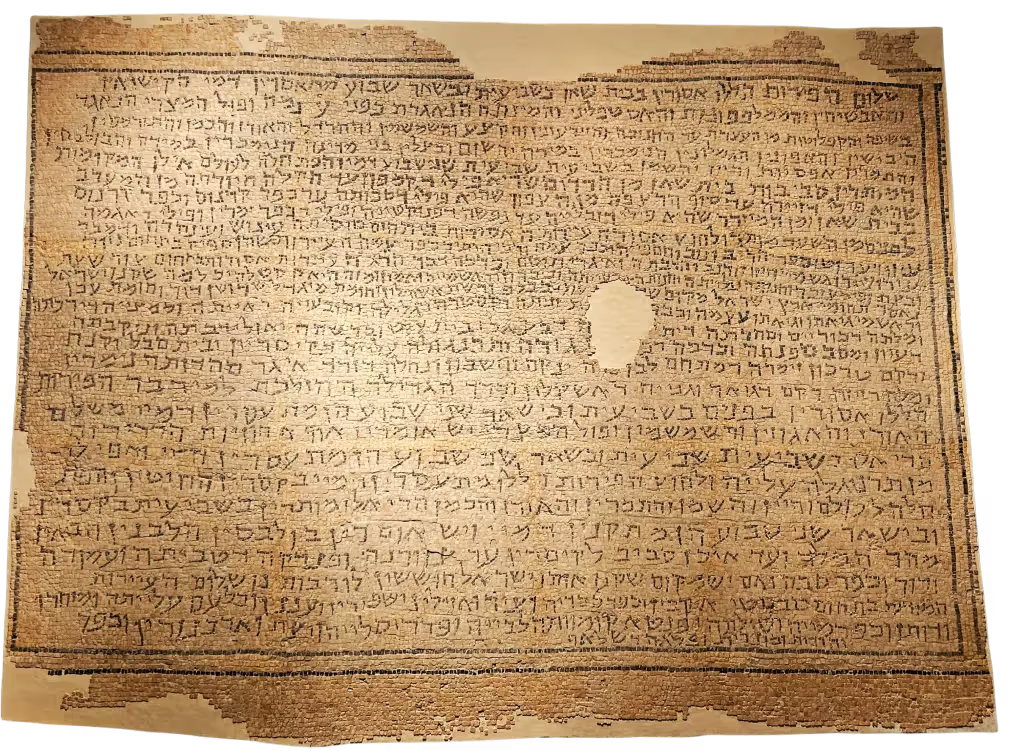
A mosaic floor inscription uncovered in the ancient synagogue of Rehov, located five kilometers south of Beit She'an, is by far the most significant archaeological evidence for the textual history of Rabbinic literature, particularly its halakhic content. The inscription mentions Jewish festivals, defines the borders of the Land of Israel as settled by returning Jews after the Babylonian exile, and also lists laws of tithing, sabbatical years, and names of 18 Jewish towns.
The inscription starts with: "Shalom. These fruits are forbidden in Beit She'an during the Seventh Year (Shmita)... the leeks from the Festival (Sukkot) until Hanukkah …”