
The Rambam - Maimonides
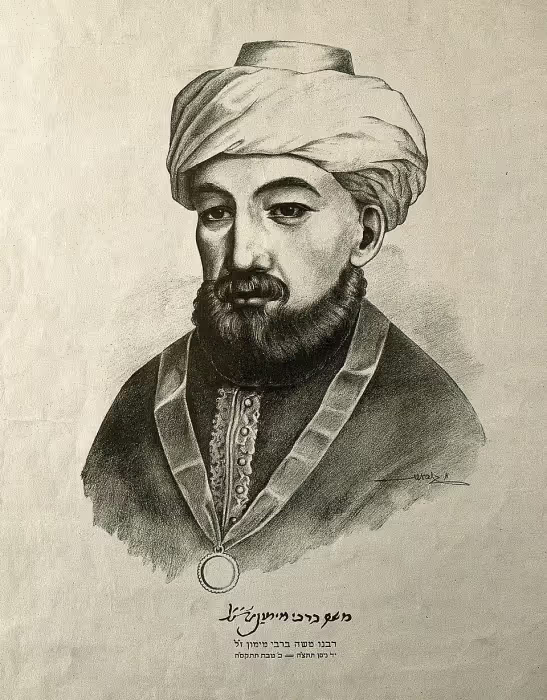
Maimonides, who was a medical doctor, philosopher, and leader of the Jewish community in Fustat, Egypt, near Cairo, lived at the time of the discovery of the texts of Greek authors, phylosiphers and scientists. His two most important works are the Mishnah Torah and the Guide for the Perplexed.
Background:
At the age of thirteen, Maimonides' family were forced to leave Cordoba when a fanatic Islamic sect took control of the city. He and his younger brother, David, moved to Morocco for five years. In 1165 CE, he visited Israel but moved to Alexandria, Egypt, and finally settled in Fustat.
Maimonides continued his Talmudic studies while his brother, a dealer in gemstones, supported the family. When David tragically passed away during a sea voyage, Maimonides was forced to take up a trade. He refused to make money from his Torah studies and became a physician. His fame as a physician spread, and he was appointed to the Court of Sultan Saladin in Cairo. He was also appointed Chief Rabbi of Cairo.
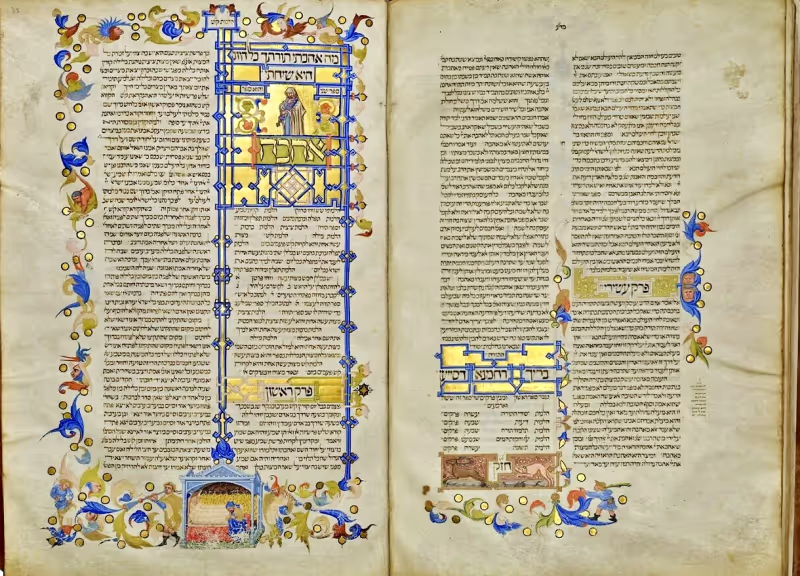
Maimonides approves a copy of his Mishneh Torah - 1180 CE
Around 200 CE, the Jewish Oral Law was compiled and written down as the Mishnah by Judah ha-Nasi.
Learn more about it HERE (Make sure to open the "Read while you listen" to get the full story behind the compilation of the Mishnah)
Learn also more about the compilation of the Talmud HERE
Maimonides worked for a decade on codifying the Mishnah which he called "Mishneh Torah", or "second to the Torah." It is a fourteen volume work giving a logical systematic codification of Jewish law, making make the Oral Law clear and accessible to all. His Mishneh Torah is regarded as a key work in rabbinical literature.
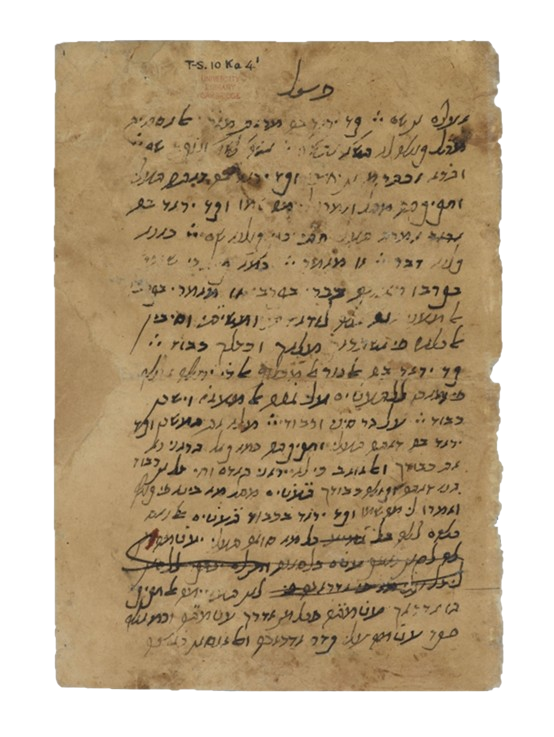
At the bottom of the manuscript it reads: “This copy has been corrected from my own book. I am Moses, son of Rabbi Maimon, a blessed memory.”

Maimonides' Life in the Courts of Saladin
Letter from Maimonides to Shmuel ibn Tibbon, the Hebrew Translator of the Guide for the Perplexed
“I dwell at Fostat, and the sultan [Saladin] resides at Cairo [about 1.5 miles away].... My duties to the sultan are very heavy. I am obliged to visit him every day, early in the morning, and when he or any of his children or any of the inmates of his harem are indisposed, I dare not quit Cairo, but must stay during the greater part of the day in the palace.
…
In consequence of this, NO JEW can have any private interview with me, except on the Sabbath. On that day the whole congregation, or at least the majority of the members, come to me after the morning service, when I instruct them as to their proceedings during the whole week; we study together a little until noon, when they depart. Some of them return, and read with me after the afternoon service until evening prayers. In this manner I spend that day.”
Maimonides (1138-1204) and Sir Isaac Newton (1642-1727)
Sir Isaac Newton is one of the greatest scientists of all time. Some of his most outstanding discoveries include the laws of optics, the laws of gravity, and the Calculus.
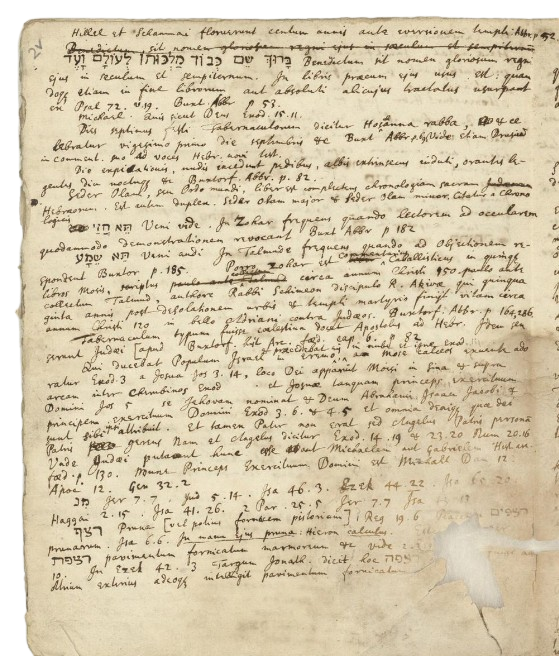
One of Newton’s manuscripts was entitled “On Maimonides,” where he quoted the Latin translation of Maimonides’ Mishneh Torah.
Newton owned a book about Maimonides that references the The Guide to the Perplexed, Maimonides’ reconciliation of religious belief with science and philosophy. This particular work seems to have had a significant impact on Newton’s philosophy. The harmony between scripture and science was a theme threaded throughout many of Newton’s works, and a means through which he carried out his theological and scientific pursuits.
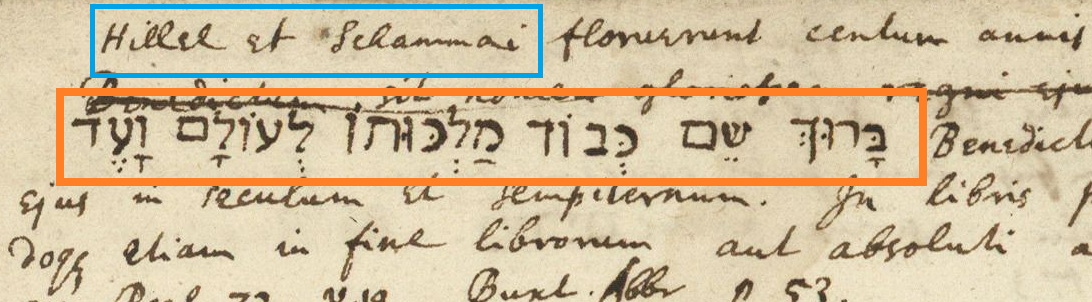
Sir Isaac Newton also mentioned Hillel and Shammai in his works and on the copy of the manuscript the blessing "“Blessed is the name of His kingdom for all eternity" can be seen written in Hebrew.
The Guide for the Perplexed
Maimonides Reconciliation of Faith and Scientific Discovery - 1190 CE
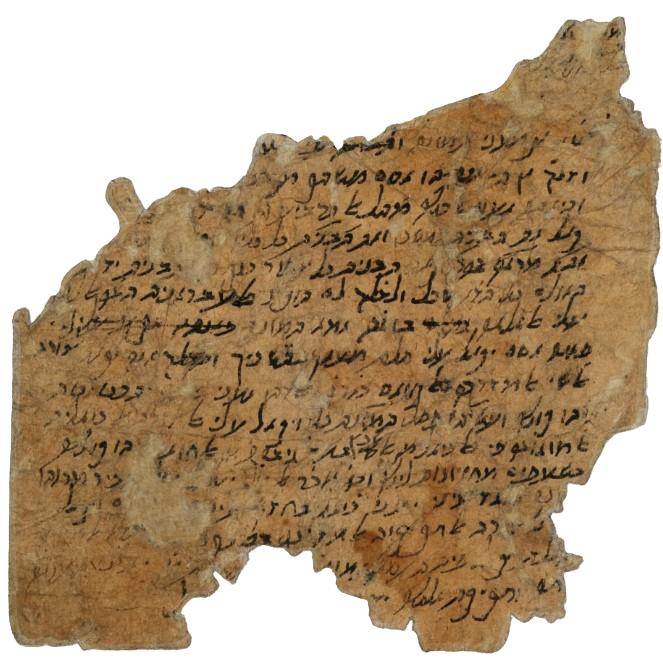
Being well-versed in the teachings of the ancient and contemporary philosophers, especially the increasing interest in the works of Aristotle and his peers, Maimonides decided to compose a systematic presentation and exposition of the fundamental religious-philosophical principles of Judaism. The Guide for the Perplexed answered the questions posed by the philosophically oriented intellectuals, helping reconcile science and religion and showing how science actually proves and bolsters one's faith, enabling those in a growing world of science and philosophy to continue to adhere to Torah-based Judaism.
According to Maimonides, the Guide for the Perplexed:
"to enlighten a religious man who has been trained to believe in the truth of our holy Law, who conscientiously fulfills his moral and religious duties, and at the same time has been successful in his philosophical studies (scientific reasoning)."